Friday, July 20, 2012

Political Graffiti - Null Votes and Cocaine Roads


The walls of Cochabamba are covered in graffiti. Some of it illegible, some of it statements of teenage adoration, but most is rooted in political adversity.

As displayed in the picture above, the walls of Cochabamba are often canvases for political messages, such as the frequent "nulo = nulo" messages spread across the city. This particular statement references several different elections in Bolivia's history when large percentages of the population chose to cast "null votes" instead of voting for candidates or reforms that were viewed as biased. For example, in 2011 there were elections to choose 56 new judiciary officials in Bolivia. The candidates, however, were chosen by Evo Morales' administration, the MAS party (socialist party), that many Bolivians view as extremely corrupt. Since the opposition was not represented in the election, about 48% of voters cast null votes, and 20% of eligible voters abstained from voting, even though it is compulsory. The ballots, however, were counted only including legitimate votes, thus only representing about 30% of the population. Graffiti around the city expresses discontent over elections like this, where null votes sometimes account for a higher percentage than any of the candidates.

Tipnis is another political topic that frequents the walls of Cochabamba, normally in the form of statements like "Defiende Tipnis" -- "Defend Tipnis." Tipnis is a region of Bolivia between the departments of Beni and Cochabamba, bordering the Amazon rain forest. The region is a protected land, home to many species of flora and fauna in danger of extinction, and home to several very rural indigenous communities. The MAS government of Evo Morales wants to build a road through the Tipnis. The reasons for this road are heavily debated. The government's political line is that the road will bring more resources to poor and rural communities and connect Bolivian communities in a manner that will improve the economy. Pretty much every Bolivian I have talked to about this matter, however, calls bullshit on the government's argument.

According to the Cochabambinos that I have spoken with, the road is a manifestation of the political control the Cocaleros (Coca growers) have on the government. The Coca Leaf is a plant grown in Bolivia (and other Latin American countries) with varying uses. Certain kinds of coca leaf are used for chewing, tea, and human consumption. Other kinds of coca leaf are used to create cocaine. And Bolivia is the third largest coca producer in the world. In the region surrounding Tipnis, the Cocaleros control nearly everything. They also do not produce the kind of coca that can be used for human consumption, and where their crop goes after it is harvested is a mystery to everyone... The argument of most Cochabambinos (and environmental organizations) is this: Evo Morales is a cocalero (this is not an argument so much as a fact since he self-identifies as such) and his administration is run based on the support of cocaleros. The cocaleros want a road that will make it easier to transport their coca crops, most of which is made into cocaine. Additionally, the cocaleros need to move off of their current land because the coca crop destroys the soil. You can only grow coca for 4-5 years (or harvests) before the soil is completely lifeless and unusable. Thus, coca plantations are constantly migrating, leaving a trail of destruction behind. If a road were to be built through Tipnis, the cocaleros could easily settle in this region and start new coca plantations. The weather and soil are ripe for coca growing and coca is an incredibly lucrative crop because of how much money the production of cocaine can produce. Environmentalist foresee this migration, and know that the Tipnis region will be destroyed if the cocaleros move in. Additionally, the indigenous communities in Tipnis don't want to the cocaleros in their communities because they do not want more drugs moving through the region. With drugs comes severe environmental impacts, not to mention violence and political corruption.

As of now, the indigenous communities have marched to La Paz (on FOOT) to protest the creation of this road. In return, the cocaleros have also marched. Construction has not started, but may be imminent. Thus, heavy political activity exists in Cochabamba in opposition to both the construction of the road and the corruption in the government based on the control of the cocaleros.

Wednesday, July 11, 2012

Ode to Julio

Our wonderful professor Julio Moreno is arriving in Cochabamba in a week! All of us are a little bit too excited about it. We decided to spell out his name using our arms in Toro Toro just to express how stoked we are.

Monday, July 9, 2012

Bitmaps

Somtimes when I am at work I play around in illustrator using bitmaps. I made these today. They are vectors, so potentially I could blow them up and actually print posters for my sweet SF apartment. It was an Albert Camus kind of today. 


Sunday, July 8, 2012

Dinosaurs, Water Falls, and Tiny Bolivian Men

This past weekend I went on an adventure with my program to Toro Toro, which is both a Bolivian National Park and a small rural town. The weekend was amazing-- My first real outdoorsy trek in South America!

Day 1 started at the FSD office at 6am where we boarded our bus for our 5 hour journey to Toro Toro. The bus was pretty nice, but the roads were ghetto-fabulous (=bad roads). The drive is almost entirely weaving through mountain passes on dirt roads that drop off into steep cliffs. Our drive is a wizard, though-- he even managed to put our bus in reverse and back us up all the way along the cliff road for about 1/2 a Kilometer in order to let a truck pass by going the other way (these are one way roads).

We got to the little town of Toro Toro at about noon and ate lunch at the one (solitary) restaurant in the town. My favorite part of the town is the signs on the trash cans that say in English: "Please do not be friends with the trash." Our hostel was adorable and even came equipped with puppies:

Please ignore gross sweats and focus only on cute puppy.
We met our guide who was the cutest and tiniest Bolivian man ever. I'm not sure how old he was, but I know he has been a guide for 43 years. He is more spry than the swiftest mountain goat and very passionate about his work. Our adventure for Friday afternoon was hiking out to a Cave. When we arrived, we realized we were in for way more than just a Cave. The "caves" of Toro Toro are actually huge, nature-made tunnels that stretch for 32 Kilometers underground. The original river that formed the caverns still exists and runs through parts of the underground labyrinth. We all got headlamps and submerged into the darkness. We traversed for about 2 kilometers in total over about 4 hours. Sometimes we were on our stomachs, pulling ourselves through tiny crevices, other times the passages would open up into big, open spaces. We even saw fish in one of the underground pools. After we left the caverns we ran into some other American backpackers, masters students who were researching a series of underground tunnels across Latin America that they hypothesize are actually connected.
The first set of Dinosaur feet! Time stamped foreva.

Entrance to the caverns.
 Day 1 ended with a delicious dinner and a walk around the town. As it turns out, the few little tiny shops that do exist in the town close well before 9pm. We were tired and went to sleep pretty early. Day 2 started with breakfast: Api (a special Bolivian corn-based hot breakfast drink), egg sandwiches, and pastel (in this case, the Pastel was essentially funnel cake). Our guide led us to a hiking trail next to a huge canyon (not Grand Canyon status but still impressive). He showed us more Dinosaur footprints which really blew my mind... I can't believe such things exist in the world. We hiked out to a look-out spot first to get a sense of the depth of the canyon. After, we hiked down to the river below. We even went swimming! It was freezing, but still a lot of fun. The waterfalls in the canyon were beautiful and the hike was pretty invigorating. We got back to the town at about 3pm and ate lunch --rice, potatoes, and chicken-- the Bolivian way! We napped for a bit, had some reflection time with our program coordinators, and after dark walked down to the river and gathered under a bridge for an impromptu rap battle. The stars were... unbelievable. I don't know if I have ever seen so many stars in my whole life.


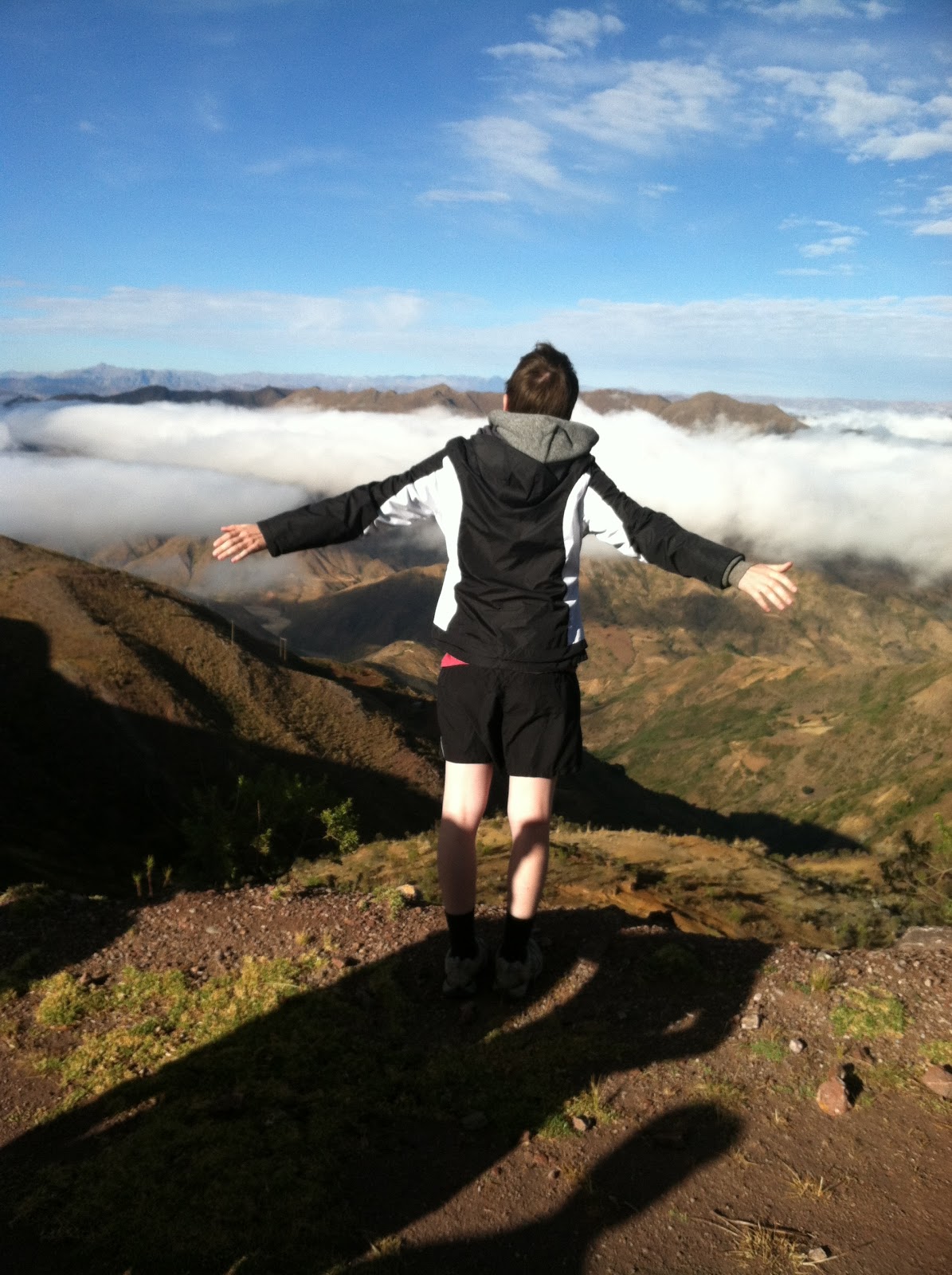
On our last day we woke up early early early and rode in the bus for about an hour up mountain after mountain, passing tiny little farm houses, herds of goats, and stretches of nature void of all humans. We got to the top of one of the peaks and hiked down into a new set of caverns. These caverns are not underground, but formed by huge boulders that create cathedral-style spaces. We hiked through several rock formations. The our guide managed to rig a rope/belt contraption so that all 13 of us could climb up the side of a sheer cliff to get to the very top of the mountain. I'm pretty shocked that nobody died, but please none the less. This hike was shorter and only lasted for about three hours. After returning to the town, we gathered our things from the hotel, and headed back across the windy, mountainous road en route to Cochabamba.
Above the clouds.


Wednesday, July 4, 2012

Queer.

It is astounding how connected the queer community is across the globe. The solidarity that exists amongst queer people consistently blows my mind. Last night, I attended the pride celebration in Cochabamba– the one day a year that gay, transgender, lesbian, bisexual, androgynous, queer, etc. people take the to the streets without fear or shame based on their sexual orientation or gender identity. The festival was amazing, inspiring, and empowering. I never expected to see so many people in the streets supporting the movement.

What’s more, however, is the sense of solidarity I feel with the queer people I meet in Cochabamba. This isn’t an isolated experience– anytime I have traveled and met other queer people, it’s the same feeling. Queers across the globe are one, interwoven community. No matter where you go, if there is a queer community and you are queer, you will be accepted. This is my experience, at least.

It’s hard to describe the experience of a transnational queer community to people who are not queer; because I can’t imagine anything quite the same exists. It’s this intrinsic understanding of respect when you meet people. No matter how alone I have felt at times this summer, or out of place I feel at straight, glamorous clubs (the type of place that checks my ID three times because my gender expression, age, and sex don't match), I know that if I can find that one queer bar, everything will be ok. Because people who are queer just get each other.

Every day in Cochabamba, somebody exclaims over my gender identity. “Lucas… why do you have a boys’ name?” or “You can’t be older than 14…” or “Are you male or female? I don’t understand.” Well, sir, I have a boy’s name because I chose that name. I’m 21 years old despite your disbelief. I am not really male or female and I would prefer not to educate you on the complexities of gender at this point in time.

But when you are in a queer place (a bar, a cafĂ©, a street corner) nobody asks those questions. There is a sense of intrinsic respect for other human beings that goes so far beyond the consciousness of much of the non-queer community. No matter how ablaze in consternation your brain might be, it really just doesn’t matter if I am a boy or a girl and, yes, I do get asked that every day. But in the queer community there is this sentiment that it just doesn’t matter because we are human and we are all fighting for both internal and external acceptance because we are all different, and weird, and abnormal. And we all make people who are not like us just a little bit uncomfortable. And because we all experience this, we are close. Surrounded by a crowd of queer people last night –drag queens, transsexual women, young gay couples, and old gay couples, single lesbian mothers– I felt more connected to complete strangers who speak different languages, believe in different religions, and experience different realities, than I feel on a street corner in the United States surrounded by other English-speaking, white, middle-class Americans.

There’s something beautiful in our struggle. There’s something beautiful in the knowledge that no matter how despised, stupid, or wrong you feel, if you can just get to that place– that place in every city where a community of people who are different and yet all so the same gather– if you can get there, you will be OK. Somebody will understand you. Somebody won’t make a face when you introduce yourself or ask you why you are who you are or, better yet, what the hell you are.

I think one of the biggest gifts I have been given in my life is to be able to experience this sense of community from some of the people who are most marginalized in this world. Although all of our struggles are different, the queer community at its core is one accumulative struggle, rooted in solidarity.

Gender Identity Awareness Project

Phase one of the Gender Identity Awareness Project is almost complete! I just submitted the final draft of my trans info packet. The packet is displayed below. I designed the whole thing. It will be distributed with my documentary and separetely in high schools.


Monday, July 2, 2012

A Night of Pride

On Saturday, the LGBT community (emphasis on the T) took to the streets of Cochabamba for the annual pride march. The festivities centered around the transsexual female community and drag community. Thousands of people came out to watch the march and support the movement. It was an incredibly moving experience and accumlated in the best night I have had so far in Cochabamba.

The irony of it all is that so many Transsexual women took the streets and were supported by the community, when any other night, many of these women would be on streets in a very different context. On those nights, the discrimination against transsexual women runs rampant. In a society where Trans women have no employment options other than sex work, it is deeply upsetting to see the Cochabambino community support their neighbors for only one night a year. I couldn't help but think, "Tomorrow, these women will be out on the streets again, but there will not be a crowd cheering them on." 

Start of the march.

Glamorous.

The outfits were incredible.

Fierce!

Dancing to Gaga.